


The new AMLR: is your firm prepared?
From 10 July 2027, the Anti-Money Laundering Regulation (AMLR) will apply directly in all EU Member States. Whereas Member States were previously able to implement their own versions, a single uniform European framework will soon apply.
For legal and financial institutions, this means that policies, processes, and risk management will have to be thoroughly reviewed. Firms that wait risk costly last-minute implementations. Those who start now will create peace of mind and control in the run-up to 2027.
.png)
Update your AML policy in time
The legislative changes require amendments to your firm’s policies and risk framework. Act in good time and have your anti-money laundering policy updated. This ensures that by July 2027 you can operate correctly and with confidence from day one.
What are the AMLR and AMLA?
The AMLR and AMLA are on their way, but what do these terms mean, and what does the new European approach mean for your firm? In this article, you can read about the impact on compliance within your organisation.
Meet the training requirements
Comply with both the requirements of the AMLR and the associated training obligations. With RegLab’s training programme, you gain practical guidance, up-to-date knowledge and immediately applicable tools to meet the statutory requirements.
Time is running out: the AMLR is coming
.png)
Looking to implement and comply with the new regulation efficiently?
RegLab is here to support you. We specifically assist:




Comply with the AMLR with ease
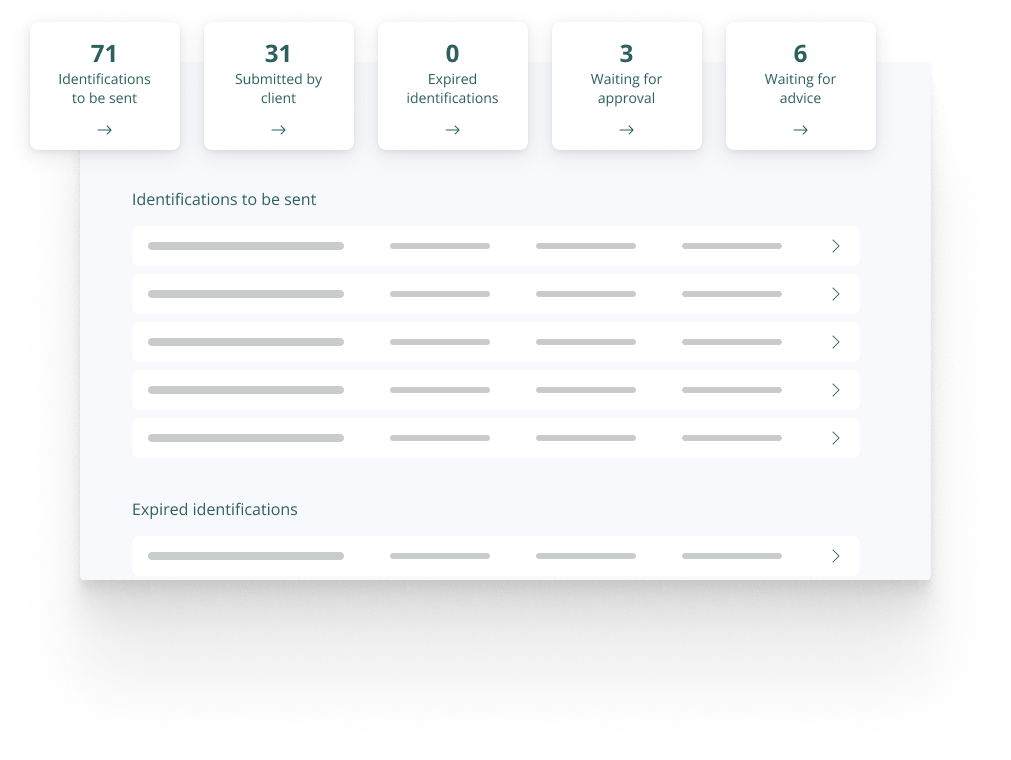
With RegLab’s software, every firm can become AMLR-ready. And client onboarding? It has never been so straightforward and efficient.
Through an identification link, clients enter all required information themselves. UBO and PEP checks, risk profiles and a complete audit trail are all handled within one structured process that is ready for the AMLR.

Compliance support for your firm
Regulation is evolving. We understand what this means. And we ensure that your firm is prepared. Our compliance specialists support you at every stage, from updating policies and risk assessments to training staff.
.png)

One step ahead of legislation
Comply with the AMLD and AMLR with confidence.
With RegLab, you are always one step ahead of regulatory change.
Frequently asked questions about the AMLR
What changes with the introduction of the AMLR compared to the AMLD and national AML legislation?
When does the AMLR enter into force?
What happens to the national AML legislation once the AMLR becomes applicable?
Who does the AMLR apply to?
The AMLR applies to all ‘obliged entities’ within the EU. This includes, among others:
- Accountants
- Lawyers
- Tax advisers
- Investment institutions
- Notaries
- Trust offices
- Real estate agents
Will sanctions under the AMLR become stricter?
The AMLR contains binding minimum requirements for sanctions and enforcement. Member States will have less scope to deviate from these requirements. This may lead to higher fines and more consistent enforcement within the EU.
In addition, the establishment of the Anti-Money Laundering Authority (AMLA) plays an important role. This European supervisory authority will have direct and indirect supervisory powers and will contribute to more uniform and intensive enforcement.
What steps should I take to ensure a smooth transition to the AMLR?
A structured approach consists of three phases.
-
Preparatory phase
Step 1: Read up on the legislation and the changes.
Step 2: Follow developments closely.
Step 3: Identify where current procedures deviate from the new AMLR requirements. Determine where you are falling short. Consider changes to the process and office and risk policy.
Step 4: Draw up action points and priorities for adjustment. Set deadlines for the transition period. This will ensure you are ready for the new legislation on time. -
Transition phase
Step 5: Inform the office about the changes. Ensure that the topic is on the agenda for colleagues in good time.Step 6: Train the office. Ensure that everyone in the office is aware of the new obligations and knows what they need to apply. Organise training courses for all relevant positions, from partners to compliance officers.
Step 7: Meet the deadlines set in step 4. - From the official effective date of AMLR
Step 8: Check that everyone in the office is applying the new legislation correctly. This can be done, for example, with an (external) audit or quality control.
How can I ensure my team is prepared for the AMLR?
First, organise or attend a training course on the AMLR requirements. But that's not all. Preparation goes beyond a one-off training course. Make sure everyone understands that the office will be switching to the new office policy and working method from 10 July 2027 and knows what this entails. Employees must:
- understand what is changing in terms of content;
- know what new obligations apply;
- be aware of their role within the modified process;
- document correctly and consistently.
This requires clear procedures, practical support and a system that structurally supports compliance. Only then will the firm be truly AMLR-proof from 10 July 2027.
Testimonial —
La Gro
"In case of questions or during implementation, there is always someone available to think with you. Even after the start-up phase, RegLab remains involved and available to support where necessary."
— Read more
Testimonial —
Banning Lawyers
"RegLab has enabled us to ensure that many matters that were non-compliant are now compliant."
— Read more
Testimonial —
KC Accounting
"With RegLab, we are not only more efficient, but also more confident that we are compliant."
— Read more
Testimonial —
Sansen International Tax Lawyers
"Compliance requirements are becoming increasingly complex. So you need a tool that is not only accurate, but also user-friendly. RegLab ticks all the boxes."
— Read more